
Hybrid (Cloud + On-Prem) Environment
📝 Context
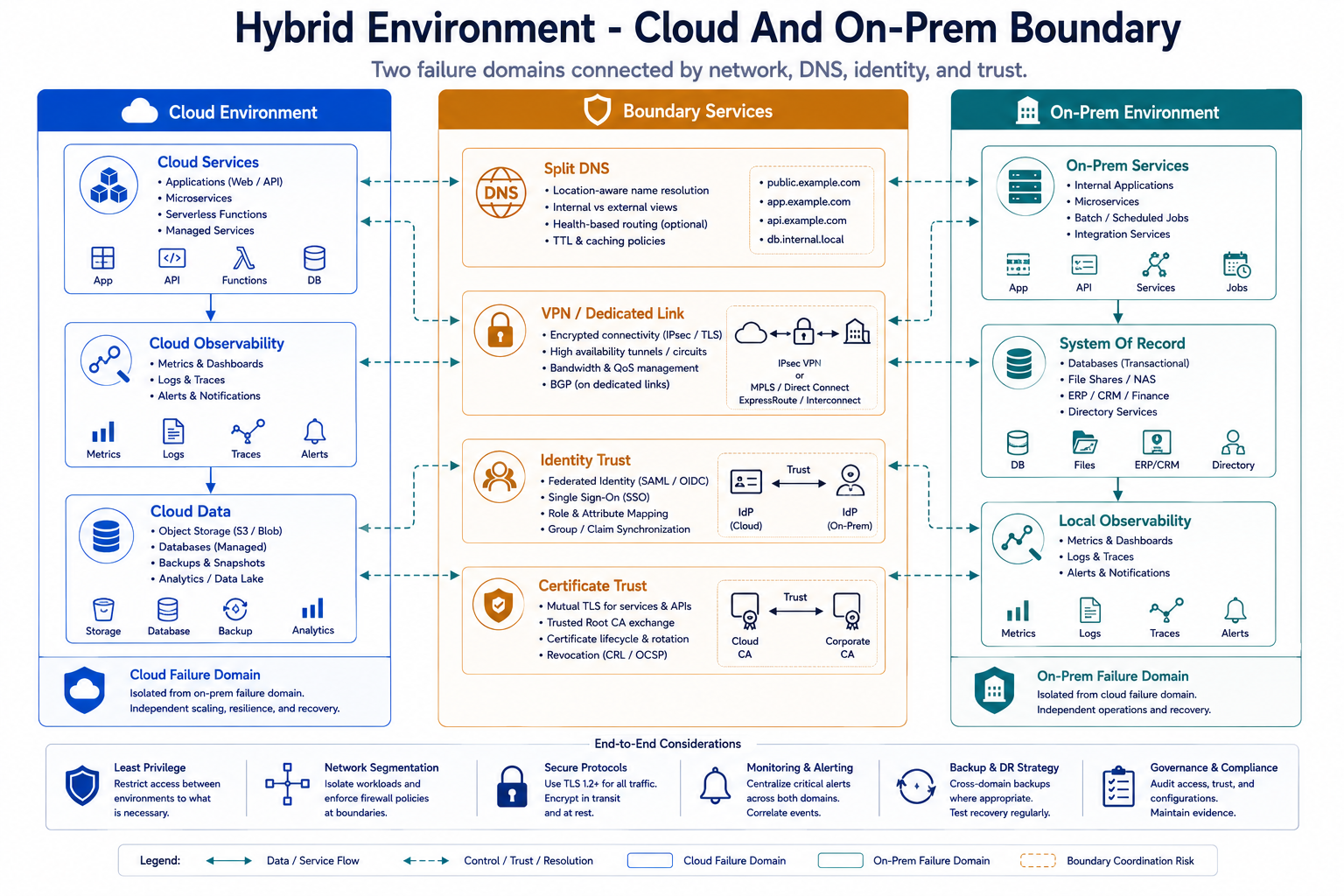
Customer has a hybrid deployment with components in both cloud and on-premises environments. This introduces connectivity, data flow, ownership, identity, and operational complexity beyond single-environment deployments. Treat the cloud and on-prem sides as separate failure domains that must be validated independently and then together.
🎯 Discovery Questions
- What components run in cloud vs. on-premises?
- How do the environments connect? (VPN, dedicated link, public internet?)
- What's the data flow between environments?
- Are there latency or bandwidth constraints between environments?
- What's the failover or disaster recovery model?
- Are there different compliance requirements for each environment?
- Who manages each environment? (Same team or different?)
- What's the network topology between environments?
- Which side owns identity, secrets, certificate issuance, DNS, and observability?
- Are there maintenance windows or change freezes on either side?
- Which environment is considered the system of record for configuration and data?
🏗️ Architecture Questions
- Where is the control plane for the solution, and where are the data-plane components?
- Which traffic flows are synchronous and user-facing versus asynchronous or batch?
- What are the expected round-trip latency, packet loss, MTU, and bandwidth numbers between sites?
- Does traffic traverse NAT, TLS inspection, private endpoints, service mesh gateways, or proxies?
- How are DNS zones split between cloud and on-prem, and who owns records in each zone?
- How are certificates issued and rotated across environments?
- What identity provider, service account, workload identity, or trust federation pattern is used?
- Which logs, metrics, traces, and audit events must cross the boundary?
- What happens if the cloud side is healthy but the on-prem side is unreachable, and vice versa?
- Are there active-active, active-passive, or manual recovery expectations?
🎯 Scoping Considerations
- Add 30-40% time buffer for hybrid deployments
- Account for connectivity setup and validation time
- Plan for cross-environment testing and validation
- Understand data residency and compliance requirements
- Consider latency and bandwidth implications
- Account for coordination between environment teams
- Plan for potential connectivity issues during deployment
- Include time for DNS, certificate, routing, proxy, and identity changes
- Schedule validation windows when both cloud and on-prem owners are available
- Document dependencies that require synchronized change approvals
✅ Validation Checklist
- [ ] Cloud-side cluster or services are reachable from the approved access path
- [ ] On-prem-side cluster or services are reachable from the approved access path
- [ ] Required cloud-to-on-prem and on-prem-to-cloud ports/protocols are tested
- [ ] DNS resolution works from both sides for every required hostname
- [ ] TLS trust chain validates from both sides, including intermediate certificates
- [ ] Identity/token exchange works across the boundary, if required
- [ ] Baseline latency, bandwidth, and packet loss are measured and documented
- [ ] Retry, timeout, and queue settings match the measured network behavior
- [ ] Logs, metrics, traces, and audit events arrive in the agreed destination
- [ ] Failure-mode tests are run for link outage, DNS failure, and one-sided service outage
- [ ] Runbooks identify the cloud owner, on-prem owner, network owner, and escalation path
🎯 Customer Communication
- Understand the hybrid architecture and data flow
- Clarify which components go where and why
- Set expectations about cross-environment connectivity
- Discuss latency and performance implications
- Establish process for coordinating between environments
- Clarify compliance and data residency requirements
- Explain that a successful deployment requires both sides to be available for validation
- Confirm who can approve emergency routing, DNS, firewall, or certificate changes
⚠️ Gotchas
- Connectivity between environments can be unreliable - test early
- Latency can cause unexpected issues - understand constraints
- Different teams may manage different environments - coordinate early
- Data residency requirements may dictate placement - clarify early
- Network topology can be complex - get diagrams
- Failover scenarios may not be tested - understand the model
- Compliance requirements may differ - understand each environment
🚨 Common Failure Modes
- DNS resolves differently in cloud and on-prem, causing traffic to use the wrong path
- NAT or overlapping CIDR ranges break return traffic or service discovery
- TLS inspection or a private CA causes certificate validation failures
- VPN or dedicated-link MTU issues show up as intermittent large-payload failures
- Identity federation works for humans but not workload/service accounts
- Observability is split, so neither team has a full view of a failed transaction
- Disaster recovery assumptions are documented but not actually tested
- One environment changes routing, certificates, or firewall rules without notifying the other team
📊 Required Diagrams / Artifacts
- Current-state and target-state network diagrams with cloud, on-prem, and boundary devices
- Data-flow diagram showing direction, protocol, port, hostname, and data classification
- Component placement matrix showing cloud vs. on-prem ownership and dependencies
- DNS and certificate inventory, including zones, issuers, trust stores, and rotation owners
- Connectivity test matrix with source, destination, port, protocol, result, and evidence
- Failure-mode runbook covering link outage, one-sided outage, credential failure, and rollback
- RACI or escalation map for cloud, on-prem, network, security, and application teams
🗣️ Customer Expectation-Setting Language
Hybrid deployments fail most often at the boundary between teams and networks, not in the application itself. We should plan a dedicated validation window where cloud, on-prem, network, security, and application owners can make and verify changes together.
We can proceed only after the required traffic flows, DNS records, certificates, and ownership model are documented. Without that, troubleshooting becomes guesswork across two environments.
Performance will be limited by the real latency, bandwidth, and reliability between sites. We will measure those numbers early and use them to set realistic success criteria.