
API Gateway Patterns
📝 Context
The customer needs a strategy for exposing services to consumers — internal teams, external partners, or public developers. An API gateway sits at the boundary between consumers and backend services, handling cross-cutting concerns like authentication, rate limiting, routing, and observability so individual services don't have to.
📋 Decision Checklist: Does This Need an API Gateway?
- [ ] Multiple backend services behind a single consumer-facing API
- [ ] Cross-cutting concerns (auth, rate limiting, logging) duplicated across services
- [ ] Need to present a stable API surface while backends evolve
- [ ] Multiple consumer types (web, mobile, partner, internal) with different API needs
- [ ] API versioning, deprecation, or lifecycle management required
If this is a single service with one consumer type: A gateway adds unnecessary infrastructure. Handle auth and rate limiting in the service directly.
"A gateway earns its place when you have several services behind one front door, or several kinds of consumers hitting them. If it's one service and one client, putting a gateway in front is just another hop to operate and pay for — I'd handle auth and limits in the service."
%%{init: {'theme': 'neutral', 'themeVariables': {'fontSize': '14px'}}}%%
flowchart LR
    Web[Web app] --> Gateway[API gateway]
    Mobile[Mobile app] --> Gateway
    Partner[Partner API] --> Gateway

    Gateway --> Auth[Auth and rate limits]
    Gateway --> Users[User service]
    Gateway --> Orders[Order service]
    Gateway --> Products[Product service]
    Gateway --> Logs[Access logs and metrics]
🧩 Worked Scenario: One Screen, One Call
A mobile app opens the order-confirmation screen. That screen needs three things — the order itself, the product details for each line item, and the customer's loyalty status. Behind the gateway those are three internal services (Order, Product, Loyalty). Instead of the app making three authenticated calls, it makes one call to a gateway endpoint shaped for this screen (a BFF route).
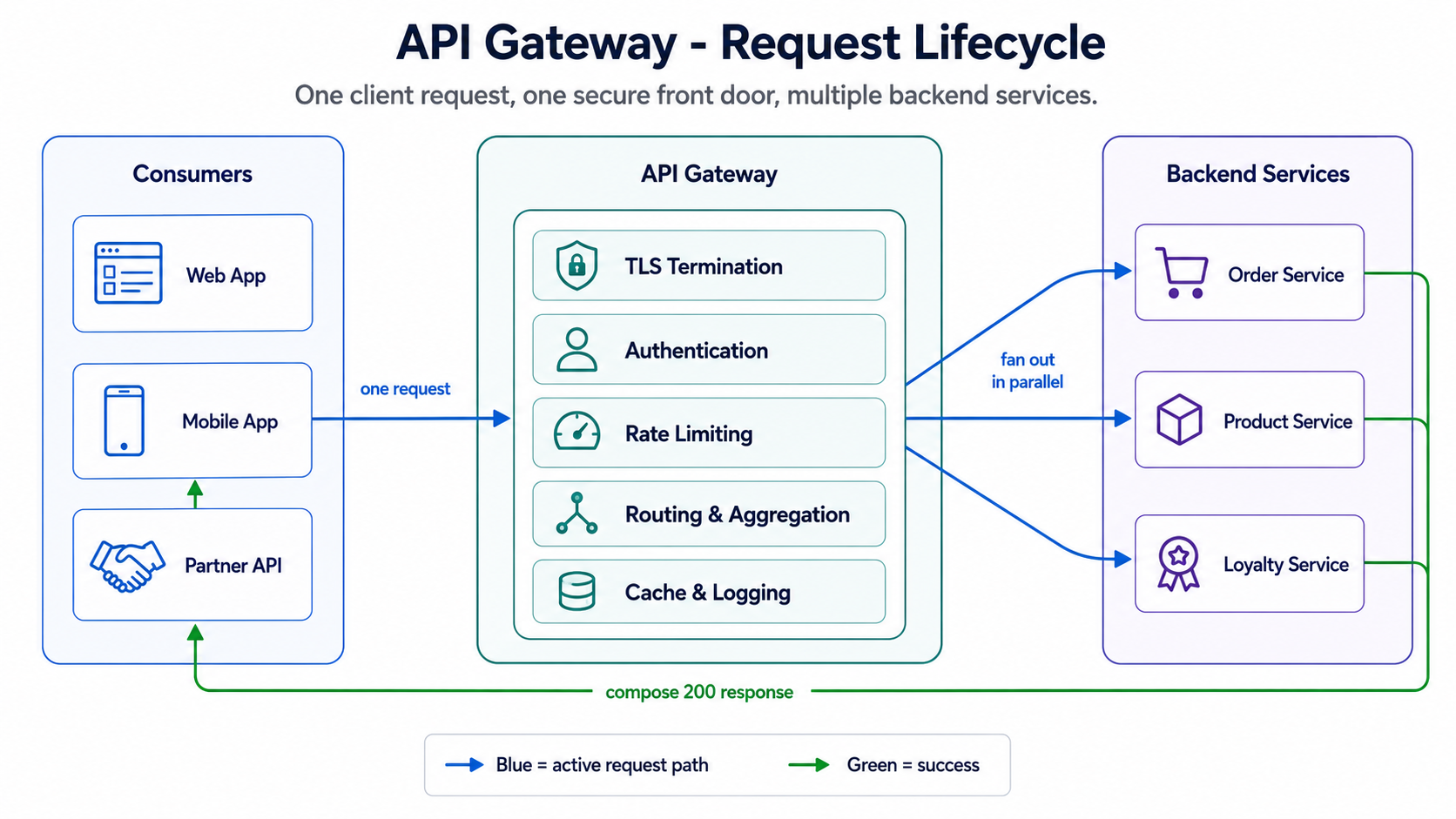
429 with Retry-After — the backends are never touched.200.Why this beats three direct calls: the app makes one round trip instead of three, the three services never implement auth or rate limiting themselves, and when the screen later needs a fourth field, the BFF route changes — not the app.
"The app makes one call to a route shaped for that screen. The gateway proves who you are, checks you're under your limit, fans out to the three services in parallel, and hands back a single payload. My services never see an unauthenticated request and never write rate-limiting code."
🎯 Core Patterns
Gateway Routing
The gateway routes requests to the appropriate backend service based on path, headers, or other request attributes.
Consumer → Gateway → /users/* → User Service
                   → /orders/* → Order Service
                   → /products/* → Product Service
Benefits: Single entry point, simplified consumer configuration, backend services can be moved or scaled independently.
Risks: Gateway becomes a single point of failure. Ensure high availability (multi-AZ, auto-scaling).
Gateway Aggregation
The gateway composes responses from multiple backend services into a single response for the consumer. Useful when a single screen or operation requires data from multiple services.
When to use:
- Mobile clients with latency sensitivity (one call better than five)
- Composing a view that spans multiple domains
- Reducing chattiness between consumer and backend
When to avoid:
- Complex business logic in the aggregation — that belongs in a service
- Aggregation requires transactional consistency — gateway can't manage transactions
Backend for Frontend (BFF)
Separate gateway instances (or configurations) for different consumer types. Each BFF is tailored to its consumer's needs.
Web App → Web BFF → Backend Services
Mobile App → Mobile BFF → Backend Services
Partner API → Partner BFF → Backend Services
Why: Web, mobile, and partner APIs have different payload requirements, authentication flows, and rate limits. A single gateway trying to serve all of them becomes bloated.
Tradeoff: Multiple gateways to maintain. Justified when consumer needs genuinely diverge.
"I reach for a BFF when the web, mobile, and partner clients start pulling the same endpoint in three directions. Rather than bloat one gateway with conditional payloads, I give each consumer a thin tailored layer over the same backends."
Gateway Offloading
Move cross-cutting concerns from individual services to the gateway:
| Concern | Gateway Handles | Service Handles |
|---|---|---|
| Authentication | Token validation, identity extraction | Authorization (what this user can do) |
| Rate limiting | Per-consumer or per-API-key throttling | Business-level quotas if needed |
| TLS termination | External TLS, certificate management | Internal mTLS (service mesh) if required |
| Request logging | Access logs, latency metrics | Business event logging |
| CORS | Preflight handling, header management | Nothing (gateway handles it) |
| Request/response transformation | Header injection, format conversion | Business logic transformation |
| Caching | Response caching for idempotent GETs | Cache invalidation signals |
API Versioning
How to evolve APIs without breaking existing consumers:
| Strategy | Mechanism | Tradeoff |
|---|---|---|
| URI versioning | /v1/users, /v2/users | Explicit, easy to route. Clutters URI space. |
| Header versioning | Accept: application/vnd.api.v2+json | Clean URIs. Less discoverable, harder to test. |
| Query parameter | /users?version=2 | Simple. Looks like a filter, not a version. |
| No versioning (additive only) | New fields added, old fields never removed | Simplest. Only works if you never break compatibility. |
Recommendation: URI versioning for external/partner APIs (explicitness wins). Header versioning or additive-only for internal APIs (less ceremony).
"For anything a partner consumes, I version in the URI — /v2/orders — because it's explicit and trivial to route. Internally, where I control both ends, I stay additive: new fields are fine, removing one is a breaking change I version for."
🛡️ Reliability & Failure Handling
A gateway is the one place that sees every request, so it's where you protect consumers from backend failures and backends from abusive load. This is the layer that separates a demo from production.
%%{init: {'theme': 'neutral', 'themeVariables': {'fontSize': '14px'}}}%%
flowchart LR
    G[API Gateway] --> H{Backend healthy?}
    H -->|No| E503[503 Service Unavailable]
    H -->|Yes| F[Forward request]
    F --> R{Response in time?}
    R -->|2xx| OK[Return 200]
    R -->|Timeout| E504[504 Gateway Timeout]
    R -->|5xx| CB{Circuit breaker open?}
    CB -->|Yes| E503
    CB -->|No| RT[Retry once or fail fast]
Rate limiting — with the numbers stated
Vague advice ("add rate limiting") invites the follow-up you can't answer. State the policy. Use a token-bucket so short bursts are allowed but sustained abuse is throttled. Limits below are illustrative — set real ones from observed traffic, not a guess.
| Caller | Limit (illustrative) | Over-limit response |
|---|---|---|
| Unauthenticated (per IP) | ~60 req/min | 429 + Retry-After |
| Authenticated (per API key) | ~1,000 req/min | 429 + Retry-After |
| Burst | token bucket refills steadily | throttle when bucket is empty |
Status codes the gateway returns
The gateway should fail in ways the consumer can act on — reject early, and never hang.
| Condition | Gateway returns | Reasoning |
|---|---|---|
| Missing / invalid token | 401 | Reject before any backend is touched |
| Authenticated but not permitted | 403 | Coarse checks at gateway; fine-grained authz in the service |
| Over rate limit | 429 | Return Retry-After so the client backs off correctly |
| Backend exceeded timeout | 504 | AWS API Gateway's default integration timeout is 29s (verified) |
| Backend unhealthy / circuit open | 503 | Health check pulled it from the pool; fail fast, don't pile on |
Backend returned 2xx | 200 | Pass through, log latency and upstream |
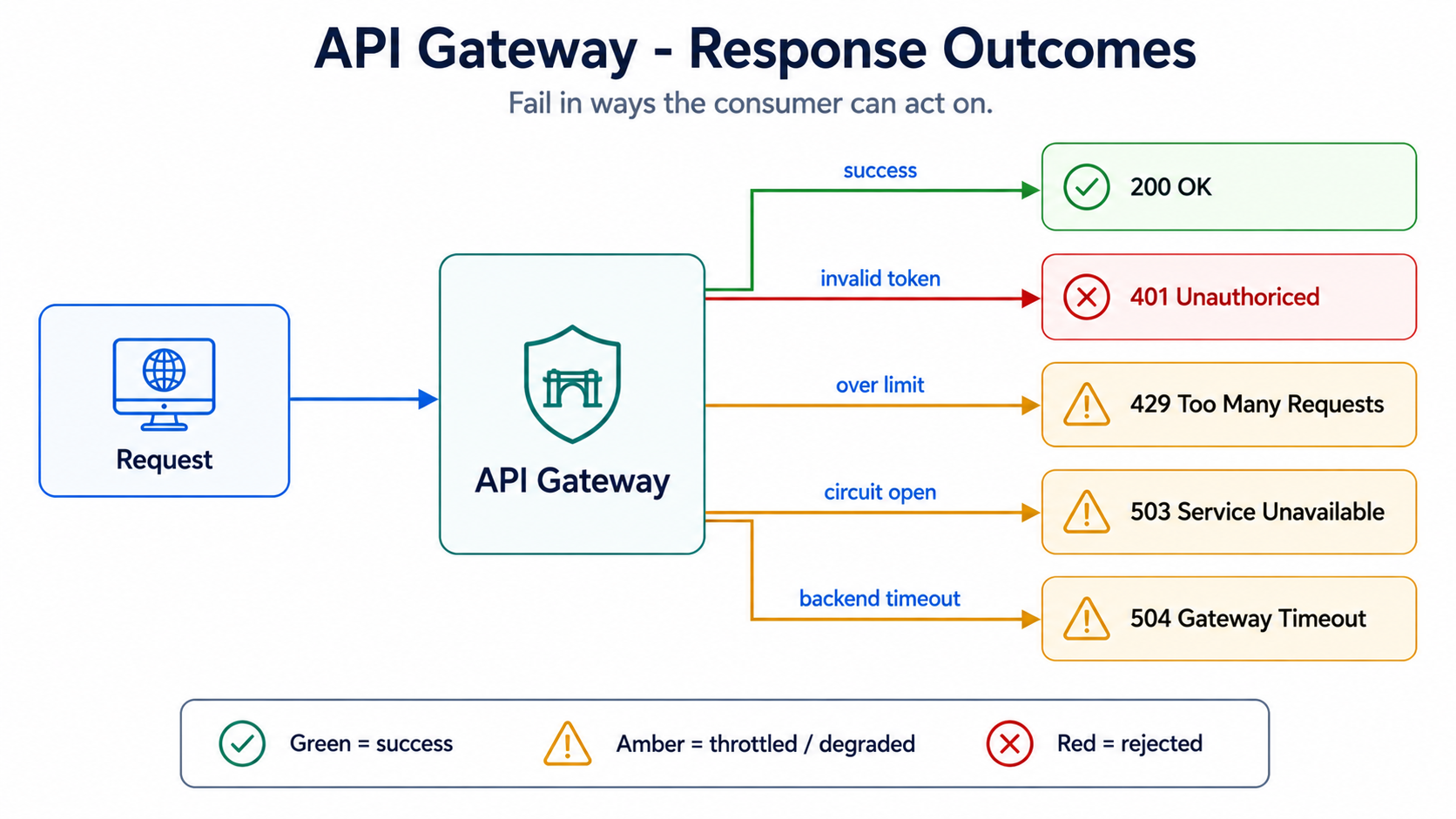
- Health checks: the gateway only routes to instances passing health checks — a dead backend is removed from rotation instead of returning errors to consumers.
- Circuit breaker: after N consecutive failures (illustrative, e.g.
5), the breaker opens and the gateway fails fast with503instead of stacking requests on a struggling service. A half-open probe after a cooldown tests recovery. - Timeouts: every hop has a budget. A consumer should get a clean
504quickly, not a 30-second hang while the gateway waits on a dead backend.
"The gateway protects the backends from each other. If the product service starts timing out, the circuit breaker opens and I return a fast 503 instead of stacking calls on a dying service — and a health check pulls the bad instance out of rotation. The consumer gets a clean status with a Retry-After, never a 30-second hang."
👁️ Observability — Who Sees What
The gateway is the natural choke point for telemetry — every request passes through it. Decide deliberately what each audience sees.
| Audience | What they see | Why it matters |
|---|---|---|
| Engineering | Per-route p99 latency, error rates, upstream health, full access logs + traces | Pinpoint the slow hop without touching production |
| Customer Success | Per-consumer request volume, error summary, which key is being throttled | Answer "why are my calls failing" without pulling in engineers |
| Partner / consumer dev | X-RateLimit-Remaining headers, 429 + Retry-After, status page, developer portal | Self-serve — they know their limits before they hit them |
| Alerting | 5xx rate / p99 latency threshold → Datadog / PagerDuty / Slack | Catch degradation before consumers report it |
"Every request gets one access log with its latency and the upstream it hit, so when someone says 'the API is slow' I point at the exact route and backend. Partners see their remaining quota in the response headers, so a 429 is never a surprise."
🎯 Technology Selection
| Technology | Type | Best For | Considerations |
|---|---|---|---|
| AWS API Gateway | Managed | REST and WebSocket APIs on AWS | Per-request pricing, 29-sec timeout, deep AWS integration |
| Kong | Self-managed or cloud | Plugin-rich, multi-cloud | Lua-based plugins, active community, operational overhead if self-managed |
| Envoy | Proxy / Service mesh | High-performance, L4/L7, gRPC-native | Often paired with Istio, steep learning curve |
| NGINX | Proxy | Simple routing, TLS termination, static config | Lightweight, proven. Limited dynamic routing without Plus. |
| Azure API Management | Managed | Azure-native APIs, developer portal | Policy-based transformation, built-in developer portal |
| Google Apigee | Managed | Enterprise API management, monetization | Full API lifecycle management, complex feature set |
| Traefik | Proxy | Kubernetes-native, auto-discovery | Integrates with K8s ingress, good for container environments |
Selection Criteria
- Managed vs. self-managed: Managed reduces operational burden but limits customization
- Protocol support: REST-only, or do you need gRPC, WebSocket, GraphQL?
- Plugin ecosystem: Can you extend it for custom auth, transformation, or validation?
- Performance: What's the latency overhead? (typically 1-5ms for well-configured gateways)
- Multi-environment: Can it run consistently across dev, staging, production?
🎯 API Design Principles for SA Engagements
When reviewing or designing APIs at the gateway layer:
- Consistency over cleverness — consistent naming, error formats, pagination across all APIs
- Consumer-first design — design the API the consumer wants to call, then figure out the backend routing
- Versioning strategy decided upfront — retrofitting versioning is painful
- Documentation as code — OpenAPI specs generated from code, not maintained separately
- Rate limiting with clear communication — return
429withRetry-Afterheader, document limits in developer portal
⚠️ Gotchas
- Gateway as the place for business logic — routing and cross-cutting concerns only
- Single gateway for all consumer types — BFF pattern exists for a reason
- No health checks on backends — gateway routes to a dead service, consumers get errors
- TLS termination at gateway without internal encryption — data is unencrypted inside the network
- Rate limits too aggressive for legitimate use — instrument first, then set limits based on real usage
- Gateway configuration drift between environments — treat gateway config as code, deploy through CI/CD
- Ignoring gateway latency in SLA calculations — every hop adds latency
🔗 Links
📚 Further reading
Gateway patterns and the security standard that applies to them:
- API Gateway pattern — microservices.io — the reference description and tradeoffs
- Backends for Frontends — Sam Newman — when to split the gateway per client
- OWASP API Security Top 10 — the vulnerabilities a gateway must help mitigate
- Envoy Proxy documentation — the data plane behind many modern gateways and meshes