
Security Architecture
📝 Context
You're designing or reviewing the security posture of a customer's architecture. Security architecture isn't a layer you bolt on after — it's a set of decisions woven into every component. Your job is to ensure the architecture implements defense in depth without creating so much friction that teams bypass controls.
📋 Security Review Checklist
- [ ] Understand the threat model — what are you protecting, from whom?
- [ ] Map trust boundaries — where does trusted meet untrusted?
- [ ] Review identity and access management
- [ ] Assess data protection (encryption, classification, lifecycle)
- [ ] Evaluate network security (segmentation, ingress/egress controls)
- [ ] Check secrets management
- [ ] Review logging and detection capabilities
- [ ] Understand incident response readiness
- [ ] Identify the customer's security team and their review process 👥
🎯 Security Architecture Framework
Defense in Depth Layers
Security architecture operates across layers. A failure at any single layer should not result in a complete breach.
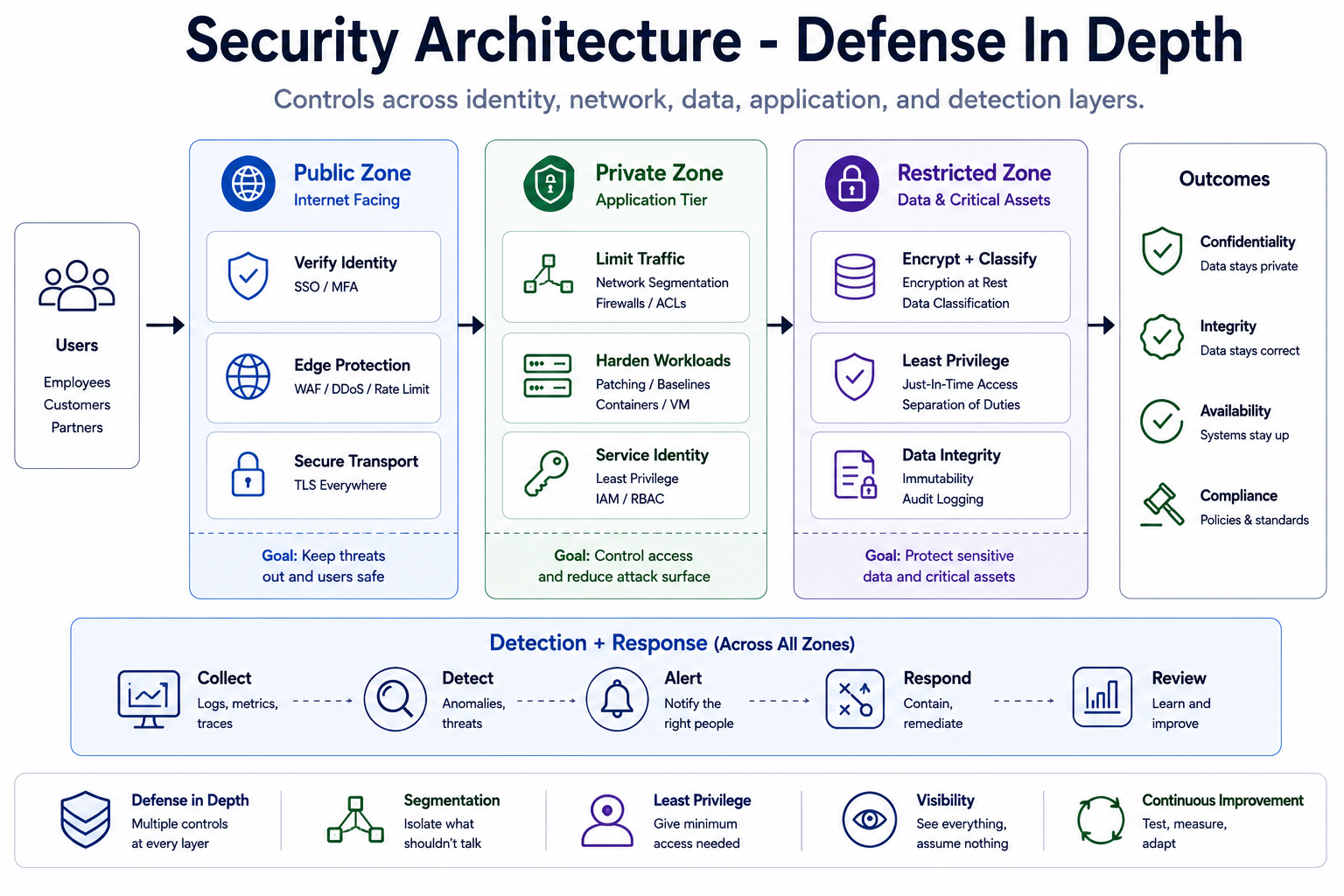
Layer 1: Identity & Access
The foundation. If you get this wrong, nothing else matters.
Authentication: How are users and services verified?
- MFA enforced for all human access
- Service-to-service authentication via mutual TLS, API keys, or IAM roles
- No shared credentials, no long-lived tokens where short-lived alternatives exist
- Session management with appropriate timeouts
Authorization: Who can do what?
- Least-privilege by default — start with no access, grant specific permissions
- Role-based (RBAC) or attribute-based (ABAC) access control
- Separate roles for read vs. write vs. admin
- Regular access reviews (quarterly minimum)
- Just-in-time privileged access with approval workflows
Identity federation: How do identities span systems?
- Centralized identity provider (IdP) for single source of truth
- SAML or OIDC for SSO across applications
- Consistent identity lifecycle (provisioning, deprovisioning)
Layer 2: Network Security
Control what can communicate with what.
Segmentation: Divide the network into zones with explicit trust boundaries
- Public-facing tier (DMZ)
- Application tier (internal)
- Data tier (most restricted)
- Management tier (admin access only)
Ingress controls: What enters the network?
- WAF for web-facing applications
- DDoS protection at the edge
- API gateway for service endpoints
- Rate limiting and throttling
Egress controls: What leaves the network?
- Explicit allowlist for outbound connections
- NAT gateway or proxy for internet access from private subnets
- DNS filtering to block known-bad domains
- Data loss prevention for sensitive data
Service mesh / network policies: How do services talk to each other?
- mTLS between services
- Network policies restricting pod-to-pod communication (in Kubernetes)
- Service-to-service authorization
Layer 3: Data Protection
Protect data at every stage of its lifecycle.
Classification: Not all data needs the same protection
- Public: No restrictions
- Internal: Access restricted to organization
- Confidential: Access restricted to specific roles
- Restricted: Subject to regulatory controls (PHI, PII, cardholder data)
Encryption:
- At rest: AES-256 with KMS-managed keys (or equivalent)
- In transit: TLS 1.2+ for all connections
- Key management: Centralized, with rotation policies
- Consider client-side encryption for the most sensitive data
Data lifecycle:
- Retention policies aligned with business and regulatory requirements
- Secure deletion when retention period expires
- Backup encryption and access controls
Layer 4: Application Security
- Input validation and output encoding
- Dependency scanning (SCA) for known vulnerabilities
- Static analysis (SAST) integrated into CI/CD
- Dynamic testing (DAST) against running applications
- Container image scanning before deployment
- Runtime protection (RASP or WAF rules)
Layer 5: Detection & Response
Logging: Centralized log collection for all layers
- Authentication events (success and failure)
- Authorization decisions (especially denials)
- Data access events for sensitive data
- Configuration changes
- Network flow logs
Monitoring & alerting:
- Anomaly detection on access patterns
- Threshold alerts for brute-force, privilege escalation
- Integration with SIEM for correlation
Incident response:
- Documented IR plan with roles and escalation paths
- Runbooks for common security scenarios
- Regular tabletop exercises
- Communication plan (internal, customers, regulators if required)
Security Architecture Assessment Template
Security Architecture Review: [Customer/Workload Name]
Threat model summary: [What are we protecting, from what threats] Compliance requirements: [HIPAA, SOC 2, PCI DSS, etc.]
| Layer | Current Maturity | Key Finding | Priority |
|---|---|---|---|
| Identity & Access | [Low/Medium/High] | [Finding] | [🔴🟡🟢] |
| Network Security | [Low/Medium/High] | [Finding] | [🔴🟡🟢] |
| Data Protection | [Low/Medium/High] | [Finding] | [🔴🟡🟢] |
| Application Security | [Low/Medium/High] | [Finding] | [🔴🟡🟢] |
| Detection & Response | [Low/Medium/High] | [Finding] | [🔴🟡🟢] |
Critical Gaps:
- [ ] [Gap with remediation]
Recommendations:
- [ ] [Recommendation with priority, effort, and owner]
⚠️ Gotchas
- Security by obscurity — hiding things is not securing them
- Over-securing low-value data while under-securing high-value data — classify first, then protect
- Security controls that teams bypass because they're too painful — controls must be usable
- No logging or detection — prevention fails; you need to know when it does
- Treating security as one team's responsibility — security is everyone's job, with a team that enables it
- Not testing incident response — an untested IR plan is not a plan
- Security review as a gate at the end — involve security architecture from the design phase
🔗 Links
- Regulatory Mapping
- Data Residency
- Well-Architected Review
- Design Review
- Private Cluster Guide
- Firewall-Restricted Guide
📚 Further reading
The control frameworks a security architecture is usually measured against:
- OWASP Application Security Verification Standard (ASVS) — a testable requirements checklist
- OWASP Top 10 — the baseline application-risk list
- NIST Cybersecurity Framework — identify/protect/detect/respond/recover structure
- NIST Zero Trust Architecture (SP 800-207) — the reference for zero-trust designs
- CIS Controls — prioritized, prescriptive safeguards