
Data Mesh Patterns
📝 Context
A customer's data platform is becoming a bottleneck — a central data team can't keep up with demand from business domains, ETL pipelines are brittle, and the data warehouse is a tangle of dependencies. Data mesh is an organizational and architectural approach that decentralizes data ownership to domain teams while maintaining interoperability through standards and self-serve infrastructure.
📋 Readiness Checklist: Is Data Mesh Right for This Customer?
- [ ] Multiple business domains generate and consume data independently
- [ ] Central data team is a bottleneck for data pipeline requests
- [ ] Domain teams have (or can develop) data engineering capability
- [ ] The organization is willing to invest in self-serve data infrastructure
- [ ] Data governance and quality standards can be enforced through platforms, not just process
- [ ] The organization has enough scale to justify the overhead (typically 50+ engineers)
If most of these are no: A well-run centralized data platform is simpler and more appropriate for smaller organizations or early-stage data maturity.
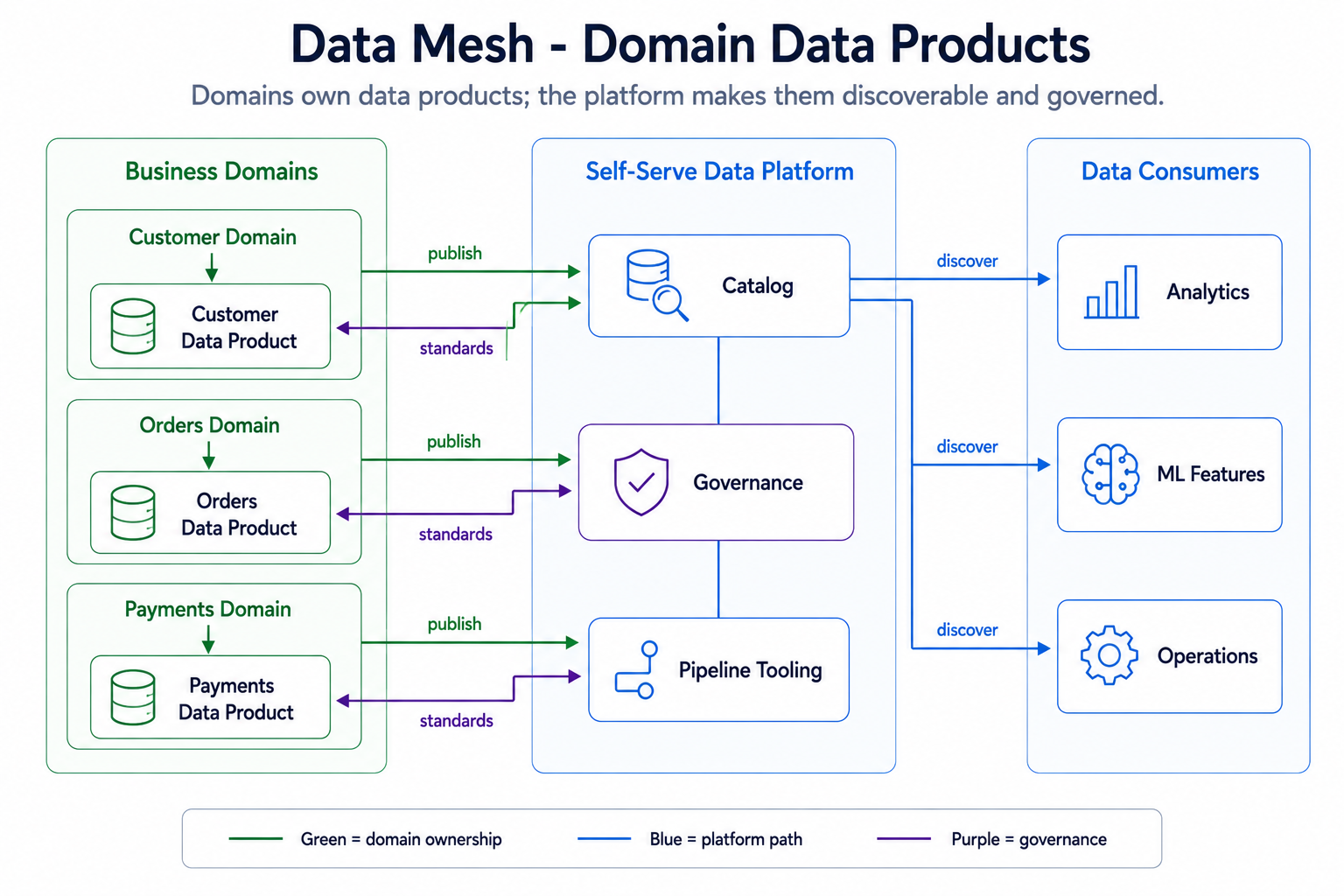
%%{init: {'theme': 'neutral', 'themeVariables': {'fontSize': '14px'}}}%%
flowchart TB
    Platform[Self-serve data platform] --> Catalog[Catalog and discovery]
    Platform --> Governance[Automated governance]
    Platform --> Infra[Storage, pipelines, quality]

    Customer[Customer domain] --> CustomerProduct[Customer data product]
    Orders[Orders domain] --> OrdersProduct[Orders data product]
    Payments[Payments domain] --> PaymentsProduct[Payments data product]

    CustomerProduct --> Catalog
    OrdersProduct --> Catalog
    PaymentsProduct --> Catalog
    Governance -. standards .-> CustomerProduct
    Governance -. standards .-> OrdersProduct
    Governance -. standards .-> PaymentsProduct
🎯 Core Principles
Data mesh is built on four principles. All four must be present — implementing one or two without the others creates a mess, not a mesh.
1. Domain-Oriented Data Ownership
Each business domain owns its data as a product. The domain team is responsible for producing, maintaining, and serving that data — not the central data team.
What this means architecturally:
- Domain teams own their data pipelines, transformations, and storage
- Data is published through well-defined contracts (schemas, SLAs, documentation)
- Each domain decides its own technology stack within platform constraints
- The central data team becomes a platform team, not a pipeline team
Example domains: Customer, Order, Inventory, Payment, Marketing, Logistics
Anti-pattern: Renaming the same centralized pipelines as "domain-owned" without actually distributing ownership, skill, or accountability.
2. Data as a Product
Data produced by a domain must be treated with the same rigor as a customer-facing product:
| Data Product Quality | What It Means |
|---|---|
| Discoverable | Other teams can find it (data catalog, search) |
| Addressable | Consistent naming and access patterns |
| Trustworthy | Quality metrics, freshness SLAs, known lineage |
| Self-describing | Schema, documentation, sample queries |
| Interoperable | Follows organizational standards for formats and protocols |
| Secure | Access controls, classification, privacy compliance |
Data product specification template:
## Data Product: [Name]

**Domain:** [Owner domain]
**Owner:** [Team name]
**Description:** [What this data represents]
**Schema:** [Link to schema definition]
**SLA:** Freshness: [X min/hours], Availability: [X%], Quality: [thresholds]
**Access:** [How to request access, what credentials/roles needed]
**Lineage:** [Source systems, transformation summary]
**Known limitations:** [What this data does NOT represent, caveats]
3. Self-Serve Data Infrastructure
A platform layer that makes it easy for domain teams to produce and consume data products without needing deep infrastructure expertise.
Platform capabilities:
- Data storage provisioning (data lakes, warehouses, databases)
- Pipeline orchestration tooling (scheduling, monitoring, retry)
- Schema registry and data catalog
- Access control and policy enforcement
- Data quality monitoring
- Cost management and chargeback
The platform team's job: Reduce the cognitive load on domain teams. A domain engineer should be able to publish a new data product in hours, not weeks.
4. Federated Computational Governance
Governance is enforced through the platform (automated policies, standards, tooling) rather than through manual review processes.
What gets federated:
- Global interoperability standards (formats, naming conventions, schema standards)
- Security and access control policies
- Data quality thresholds
- Privacy and compliance rules (classification, retention, masking)
- Cost guardrails
What stays with domains:
- Schema design within their bounded context
- Pipeline implementation and scheduling
- Technology selection within platform constraints
- Data product roadmap and prioritization
🎯 Implementation Approach
Phase 1: Foundation
- Establish the platform team and initial self-serve capabilities
- Pick 1-2 mature domains to pilot data product ownership
- Define interoperability standards (file formats, schema registry, naming conventions)
- Implement a data catalog for discoverability
Phase 2: Expand
- Onboard additional domains
- Build out data quality monitoring and SLA tracking
- Implement automated governance policies
- Establish cross-domain data product consumption patterns
Phase 3: Scale
- All major domains producing data products
- Self-serve infrastructure handles common patterns without platform team involvement
- Governance is primarily automated
- Federated governance council meets regularly to evolve standards
🎯 Common Data Mesh Architectures
Lakehouse per domain: Each domain has its own lakehouse (Delta Lake, Iceberg) with a shared catalog layer for cross-domain discovery.
Domain-owned pipelines with shared warehouse: Domains own their transformations but publish to a shared analytical warehouse with domain-scoped schemas.
Event-driven data products: Domains publish data as event streams (Kafka topics). Consumers materialize views for their needs. Strongest decoupling but highest complexity.
See also: Event-Driven Patterns
⚠️ Gotchas
- Data mesh without platform investment — domain teams can't build infrastructure from scratch
- Treating data mesh as a technology choice — it's primarily an organizational change
- Implementing all four principles simultaneously — phase the rollout, starting with ownership and product thinking
- Domains producing data with no consumers — build for actual demand, not theoretical completeness
- No interoperability standards — without standards, you get data islands instead of a mesh
- Underestimating governance — federated governance is harder than centralized governance, not easier
- Small organizations adopting data mesh — the overhead doesn't pay off below a certain scale
🔗 Links
📚 Further reading
The source material that defined data mesh:
- Data Mesh Principles and Logical Architecture — Dehghani — the four principles in depth
- How to Move Beyond a Monolithic Data Lake — Dehghani — the original data mesh article
- Data Mesh Learning — community patterns, talks, and case studies
- Data Contracts — a concrete interoperability standard for data products