
Event-Driven Architecture Patterns
📝 Context
The customer is considering or already using an event-driven architecture — systems that communicate through events rather than direct calls. Event-driven patterns enable loose coupling, scalability, and real-time reactivity. They also introduce complexity in debugging, ordering, and consistency that must be deliberately managed.
This page is built to be usable on a whiteboard. Each section pairs the concept with a worked example and a talk track — the sentence you actually say when a customer or interviewer asks "okay, but how would that work for us?"
📋 Decision Checklist: Should This Be Event-Driven?
- [ ] Producers and consumers have different availability or scaling requirements
- [ ] Multiple consumers need to react to the same event independently
- [ ] The system needs to handle bursty or unpredictable load
- [ ] Temporal decoupling is valuable (producer doesn't need to wait for consumer)
- [ ] An audit trail of all events is valuable
- [ ] Eventual consistency is acceptable for this use case
If most of these are no: Synchronous request-response is simpler and easier to debug. Don't add event infrastructure for a system that's fundamentally request-response.
%%{init: {'theme': 'neutral', 'themeVariables': {'fontSize': '14px'}}}%%
flowchart TD
    A[Do multiple consumers need the same event?] -->|Yes| B[Publish-subscribe]
    A -->|No| C[Is this work processed by one worker?]
    C -->|Yes| D[Point-to-point queue]
    C -->|No| E[Is replay or audit trail required?]
    E -->|Yes| F[Event streaming]
    E -->|No| G[Prefer synchronous request-response]

    B --> H[Check ordering and idempotency]
    D --> H
    F --> H
"Before I sketch anything — is this one event that one service consumes, or one event that several teams need to react to independently? That single answer decides whether we reach for a queue or a pub-sub topic."
🧩 Worked Scenario: Order Fan-Out
The canonical event-driven case. An e-commerce platform (say, Shopify) records an order. Three downstream systems must react — billing, inventory, and customer notifications — each with different ownership, availability, and scaling needs.
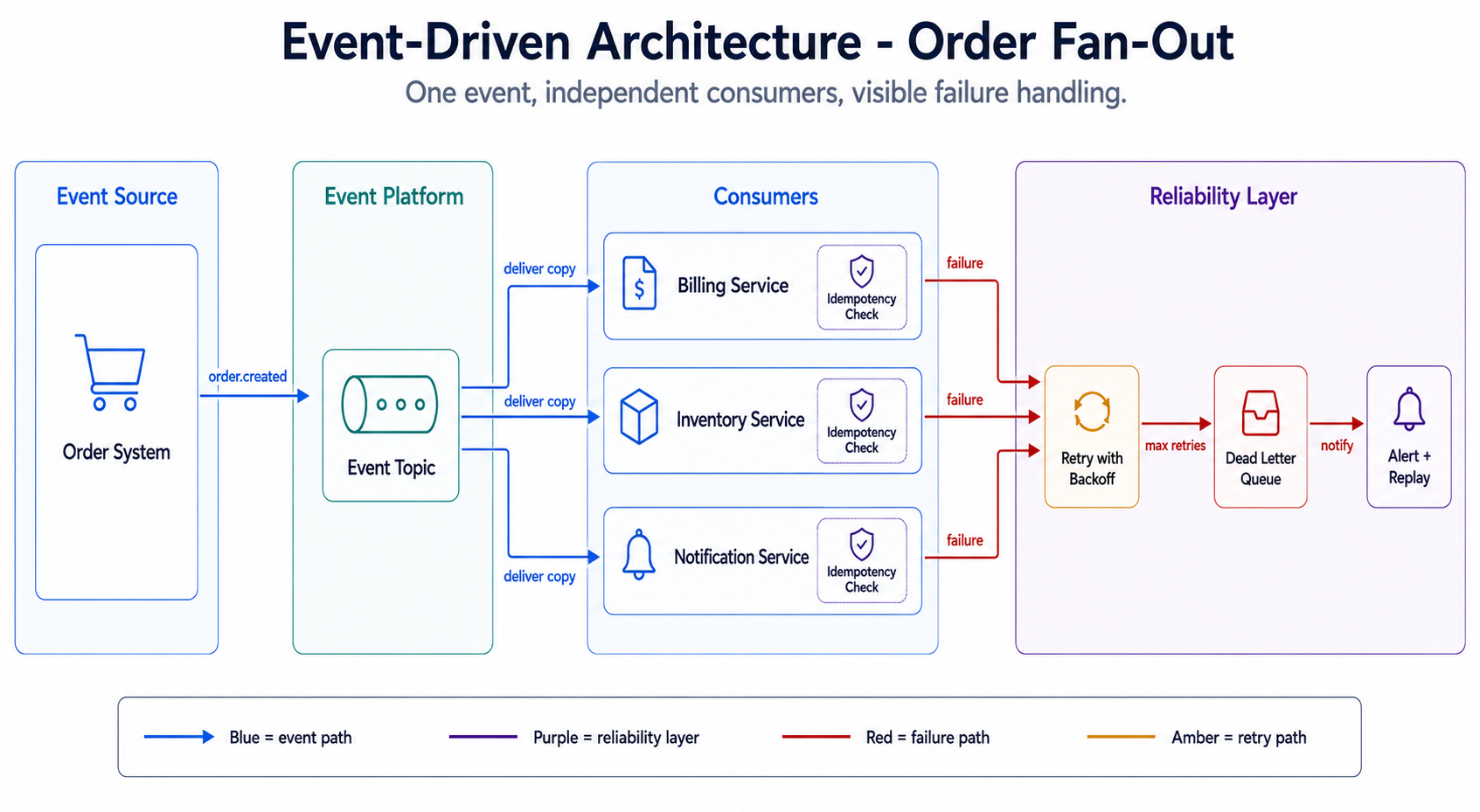
order.created event. It does not know or care who consumes it.Why this beats direct calls: if the order system called billing → inventory → notifications synchronously, one slow or down service would fail the whole order, and adding a fourth consumer later would mean changing the order system. With fan-out, the order system never changes when a new consumer is added.
"The order system emits one fact — 'this order happened' — and walks away. Billing, inventory, and notifications each pick it up on their own schedule. When you add a fourth consumer next quarter, the order system doesn't change a single line."
🎯 Core Patterns
Event Types
Not all events are the same. Clarify which type you're working with — it changes how much data travels and whether consumers must call back to the source.
| Type | Description | Example | Consumer Behavior |
|---|---|---|---|
| Notification | Something happened. Minimal data. | "Order 123 was placed" | Consumer fetches details from source if needed |
| Event-carried state transfer | Something happened, and here's all the data you need. | "Order 123 placed: {items, total, customer}" | Consumer acts without calling back to source |
| Domain event | A meaningful business occurrence in a bounded context. | "InventoryReserved" | Triggers downstream business logic |
| Command | A request for action disguised as a message. | "ProcessPayment" | Receiver is expected to act — this is async RPC, not pure event-driven |
The trade-off that matters: notifications keep payloads small but create chatty callbacks to the source (and couple consumers to source availability). Event-carried state transfer eliminates the callback but risks stale or bloated payloads and leaks the source's schema to every consumer. Choose per event, not per system.
Messaging Patterns
Publish-Subscribe — Producer publishes to a topic; multiple consumers subscribe and receive independently; consumers don't know about each other. Best for fan-out, multiple teams reacting to the same event.
Point-to-Point Queue — Producer sends to a queue; exactly one consumer processes each message; messages consumed once. Best for task distribution, work queues, ordered processing.
Event Streaming — Events written to an append-only log (Kafka, Kinesis, Pulsar); consumers read from an offset and can replay; the log retains events for a configurable window. Best for audit trails, event sourcing, and consumers running at different speeds.
Processing Patterns
- Simple event processing: one event triggers one action. "Order placed" → "send confirmation email."
- Event correlation: multiple events combine to trigger an action. "Payment received" + "inventory reserved" → "ship order." Requires a correlation mechanism (saga, process manager).
- Complex event processing (CEP): pattern detection across a stream. "More than 5 failed logins in 60 seconds from one IP" → "block IP." Requires a streaming processor (Flink, KSQL, Spark Streaming).
Delivery Guarantees
| Guarantee | Meaning | Implementation Cost | When Required |
|---|---|---|---|
| At-most-once | May be lost, never duplicated | Lowest — fire and forget | Metrics, analytics where loss is acceptable |
| At-least-once | Will arrive, possibly more than once | Medium — requires acknowledgment + retry | Most business events — consumer must be idempotent |
| Exactly-once | Arrives exactly once | Highest — requires transactions or dedup | Financial transactions, inventory counts |
Default to at-least-once with idempotent consumers. Exactly-once is expensive and fragile. Making consumers handle duplicates gracefully is almost always cheaper than achieving true exactly-once delivery — and it degrades better under failure.
"I'd use at-least-once delivery and handle de-duplication on the receiver using the event ID as the key. That's cheaper and more resilient than chasing exactly-once across the network."
🛡️ Reliability & Error-Handling Layer
This is the layer that separates a demo from a production system. When a consumer or destination is down, what happens to the event?
%%{init: {'theme': 'neutral', 'themeVariables': {'fontSize': '14px'}}}%%
flowchart LR
    E[Event arrives] --> Q[Queue]
    Q --> W[Worker processes]
    W --> R{2xx success?}
    R -->|Yes| OK[Ack and done]
    R -->|No| RT[Retry with backoff]
    RT --> X{Max retries hit?}
    X -->|No| W
    X -->|Yes| DLQ[Dead Letter Queue]
    DLQ --> A[Alert + manual replay]
Retry policy — with the numbers stated
Vague advice ("use exponential backoff") is what gets you a follow-up question you can't answer. State the actual policy.
| Attempt | Delay | Why |
|---|---|---|
| Retry 1 | ~1s | Most transient blips clear immediately |
| Retry 2 | ~2s | Delay doubles each attempt (exponential backoff) |
| Retry 3 | ~4s | Backs off further so a struggling endpoint can recover |
| After max | Cooldown, then DLQ | Stop hammering; quarantine for review/replay |
- Exponential backoff: the retry interval doubles each attempt so you don't hammer a struggling endpoint.
- Jitter: add randomness to each delay so all consumers don't retry at the exact same instant. Prevents a thundering-herd retry storm.
- DLQ after max: failed messages move to a dead letter queue for investigation and replay — never silent loss.
Status codes drive the next action
The single highest-signal detail in this whole topic. Retrying blindly on every failure is a junior mistake.
| Response | Action | Reasoning |
|---|---|---|
| 2xx | Acknowledge, done | Success |
| 429 | Back off — never retry immediately | Rate limited; immediate retry makes it worse |
| 5xx | Retry with backoff | Server-side, likely transient |
| 4xx (not 429) | Do not retry → DLQ | Bad request won't fix itself on retry |
"On a 5xx I retry with exponential backoff and jitter. On a 429 I back off — never retry immediately, that just deepens the rate-limit hole. On a 4xx I don't retry at all; the payload is bad, so it goes straight to the dead letter queue for review."
🔁 Idempotency
Definition: an operation is idempotent if running it multiple times produces the same result as running it once. Because at-least-once delivery means the same event can arrive more than once, every consumer doing a state change must handle duplicates safely.
The mechanism: an idempotency key — a unique ID on the event, usually the source's event or record ID. Before processing, check whether you've seen this key. If yes, skip. If no, process and record the key.
| Scenario | Risk without idempotency | Fix |
|---|---|---|
| Payment event fires twice | Customer charged twice | Check event ID before processing; store processed IDs |
| Record created twice | Duplicate data in destination | Upsert on external ID, not blind insert |
| Retry after a timeout | First delivery succeeded but the response was lost | At-least-once + idempotency key = safe |
"I assume every event can be delivered twice, so consumers upsert on the source record ID instead of inserting. The duplicate becomes a no-op instead of a double charge."
👁️ Observability — Who Sees What
A reliable system that nobody can see into still generates support tickets. Decide deliberately what each audience sees.
| Audience | What they see | Why it matters |
|---|---|---|
| Engineering | Full execution logs, payload inspection, step-by-step trace | Diagnose failures fast without touching production |
| Customer Success | Per-customer status, error summaries, a replay button | CS resolves common issues without pulling in engineers |
| End customer | Health status, last-run time, self-serve retry | Trust — they don't file tickets for things they can fix |
| Alerting | Stream to Datadog / PagerDuty / Slack on threshold breach | Catch failures before the customer reports them |
"The goal is that a failure is visible and recoverable, not silent. Engineering gets the stack trace, CS gets a replay button, and the customer gets a health indicator — so most issues never become a ticket."
🎯 Technology Selection
| Technology | Pattern | Ordering | Retention | Best For |
|---|---|---|---|---|
| AWS SQS | Queue | Per-queue (FIFO) or best-effort | 14 days max | Simple work queues, decoupled processing |
| AWS SNS | Pub-sub | No ordering guarantee | None | Fan-out notifications |
| Apache Kafka | Streaming | Per-partition | Configurable (days to indefinite) | High-throughput streaming, event sourcing |
| AWS Kinesis | Streaming | Per-shard | 1–365 days | AWS-native streaming alternative to Kafka |
| RabbitMQ | Queue + Pub-sub | Per-queue | Until consumed | Flexible routing, complex topologies |
| Azure Service Bus | Queue + Pub-sub | Per-queue (sessions) | Configurable | Enterprise messaging with transactions |
| Google Pub/Sub | Pub-sub | Per-subscription (ordering key) | 31 days | GCP-native event distribution |
Selection Criteria
- Throughput: events per second? Kafka and Kinesis handle millions; SQS handles tens of thousands.
- Ordering: must events process in order? Kafka guarantees per-partition; SQS FIFO guarantees per-group.
- Retention: need to replay? Kafka retains indefinitely; SQS discards after consumption.
- Operational burden: managed (SQS, SNS, Pub/Sub) vs. self-managed (Kafka — powerful but operationally expensive).
- Ecosystem fit: already run Kafka? Don't add SQS. Already on AWS for simple queuing? Don't add Kafka.
⚠️ Gotchas
- Treating everything as an event — synchronous calls are fine when you need an immediate response.
- No dead letter queue — failed messages disappear silently and data is lost.
- Ordering assumptions — most systems guarantee only per-partition/group order, never global.
- Consumer lag going unmonitored — a consumer falling behind is a ticking time bomb.
- Not making consumers idempotent — at-least-once delivery means duplicates happen.
- Event schemas without versioning — schema changes silently break consumers.
- "We'll just use Kafka" for simple queuing — SQS handles simple cases with zero operational overhead.
- No replay strategy — when something breaks, you want to reprocess from a known point.
🔗 Links
📚 Further reading
Foundational writing on events, streaming, and consistency:
- What do you mean by "Event-Driven"? — Fowler — untangles the four common event patterns
- Event Sourcing — Fowler — the canonical description of the pattern
- Saga pattern — microservices.io — managing consistency across services without distributed transactions
- Apache Kafka documentation — the reference for log-based event streaming
- AWS Event-Driven Architecture — managed building blocks (EventBridge, SNS/SQS, Kinesis)