
Microservices Architecture Patterns
📝 Context
A customer is considering microservices, already running them, or dealing with the consequences of a microservices migration. Your job is to help them understand when microservices are the right choice, what patterns to apply, and how to avoid the common failure modes that turn a microservices architecture into a distributed monolith.
📋 Decision Checklist: Should This Be Microservices?
Before recommending microservices, validate these prerequisites:
- [ ] Multiple teams need to deploy independently (organizational driver)
- [ ] Services have genuinely different scaling requirements
- [ ] Domain boundaries are well understood (not still being discovered)
- [ ] Team has operational maturity for distributed systems (monitoring, tracing, incident response)
- [ ] CI/CD pipeline supports per-service deployment
- [ ] The complexity cost is justified by the independence gained
If most of these are no: A well-structured monolith or modular monolith is probably the better choice. Microservices are an organizational scaling pattern, not a technical improvement for small teams.
%%{init: {'theme': 'neutral', 'themeVariables': {'fontSize': '14px'}}}%%
flowchart TD
    A[Do multiple teams need independent deployment?] -->|No| B[Prefer modular monolith]
    A -->|Yes| C[Are domain boundaries well understood?]
    C -->|No| D[Stabilize domain model first]
    C -->|Yes| E[Can the team operate distributed systems?]
    E -->|No| F[Invest in CI/CD, tracing, and ownership]
    E -->|Yes| G[Do services scale or change independently?]
    G -->|No| B
    G -->|Yes| H[Microservices may be justified]
🎯 Core Patterns
Service Decomposition
How to draw service boundaries:
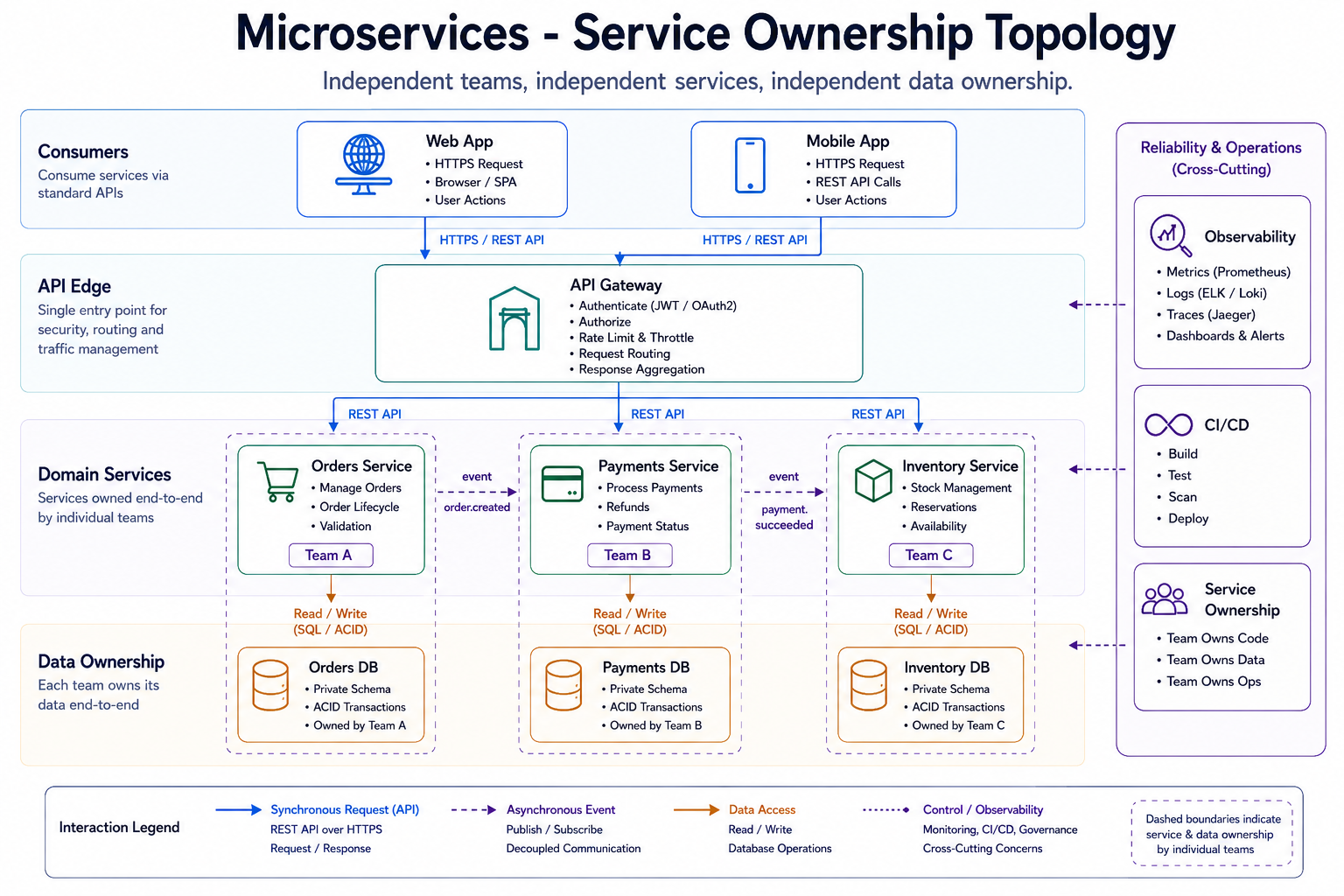
By business domain (Domain-Driven Design) — each service owns a bounded context with its own data, logic, and API. This is the strongest decomposition strategy because it aligns service boundaries with organizational boundaries.
By data ownership — each service owns its data store. If two services need the same data, one owns it and the other requests it via API. Shared databases are the fastest path to a distributed monolith.
By rate of change — services that change frequently should be independent from services that are stable. This minimizes deployment risk.
Anti-patterns in decomposition:
- Services split by technical layer (API service, business logic service, data service) — this creates distributed layers, not independent services
- Services that can't function without synchronous calls to 3+ other services — this is a distributed monolith with network overhead
- Services with shared databases — coupling at the data layer defeats the purpose
Communication Patterns
| Pattern | When to Use | Tradeoffs |
|---|---|---|
| Synchronous REST/gRPC | Request-response where the caller needs an immediate answer | Simple, but creates temporal coupling. Caller blocks until response. Cascading failures if downstream is slow. |
| Async messaging (queues) | Work that can be processed later, decoupled producers and consumers | Decouples services, absorbs load spikes. Harder to debug, eventual consistency. |
| Event streaming (Kafka, etc.) | Multiple consumers need the same event, event sourcing, audit trails | Scalable, replayable. Operational complexity, ordering challenges. |
| Choreography | Services react to events independently, no central coordinator | Loose coupling. Hard to understand the full flow, hard to handle failures. |
| Orchestration (Saga) | Multi-step workflows that span services and need coordination | Clear flow, easier error handling. Central coordinator can become a bottleneck. |
See also: Event-Driven Patterns
Data Management
Database per service: Each service owns its data store. This is the default for microservices. The consequence is that cross-service queries require API calls or materialized views.
Saga pattern for distributed transactions: When a business operation spans multiple services, use a saga (sequence of local transactions with compensating actions) instead of distributed transactions. Distributed transactions (2PC) don't scale and create tight coupling.
CQRS (Command Query Responsibility Segregation): Separate the write model from the read model when query patterns differ significantly from write patterns. Common in event-sourced systems.
Event sourcing: Store state as a sequence of events rather than current state. Provides complete audit trail and enables temporal queries. Adds significant complexity — use only when the audit trail or temporal capability is a hard requirement.
Resilience Patterns
Circuit breaker: When a downstream service is failing, stop calling it temporarily to prevent cascading failures. After a timeout, try again (half-open state). If it succeeds, close the circuit. If it fails, keep it open.
Retry with exponential backoff: Retry transient failures, but increase the delay between retries to avoid overwhelming a recovering service. Add jitter to prevent thundering herd.
Bulkhead: Isolate resources (thread pools, connection pools) per downstream dependency so a slow service can't consume all resources and affect calls to healthy services.
Timeout: Set explicit timeouts on all inter-service calls. A service without a timeout will wait forever for a response that may never come.
Fallback: When a dependency fails, degrade gracefully. Serve cached data, return a default, or skip the feature rather than failing the entire request.
Observability
You cannot run microservices without distributed tracing, centralized logging, and service-level metrics. This is not optional.
- Distributed tracing: Trace requests across service boundaries (Jaeger, Zipkin, OpenTelemetry)
- Centralized logging: All service logs in one place with correlation IDs
- Service metrics: Latency, error rate, throughput per service (RED metrics)
- Service dependency map: Visualize which services call which, with latency and error data
- Alerting: Per-service SLOs with alert thresholds
🎯 Evaluating a Customer's Microservices Architecture
When reviewing an existing microservices architecture, look for:
| Smell | What It Indicates | Recommendation |
|---|---|---|
| Services that always deploy together | Boundary is wrong — these are one service | Merge them |
| Shared database between services | Data coupling defeating independence | Migrate to database-per-service |
| Synchronous call chains 4+ deep | Distributed monolith | Introduce async messaging, rethink boundaries |
| No distributed tracing | Incidents take hours to diagnose | Implement OpenTelemetry before adding more services |
| Every service is a different tech stack | "Polyglot" taken too far | Standardize on 2-3 stacks maximum |
| 50 services for a 5-person team | Over-decomposed | Consolidate into fewer, coarser services |
⚠️ Gotchas
- Microservices as a default — they're a tool for organizational scaling, not a universal architecture
- Decomposing too early — break apart a monolith when you understand the domain boundaries, not before
- Shared databases — the single most common way to accidentally build a distributed monolith
- Ignoring operational cost — each service needs monitoring, logging, deployment pipeline, on-call coverage
- No service ownership model — every service needs a team that owns it
- Testing in isolation without integration tests — unit tests pass, production breaks
- "Let's use a different language for each service" — polyglot is a liability at small team sizes
🔗 Links
- Event-Driven Patterns
- API Gateway Patterns
- Data Mesh Patterns
- Design Review
- Reference Architectures
- Well-Architected Review
📚 Further reading
The canonical microservices literature:
- microservices.io — Chris Richardson's pattern catalog (decomposition, data, deployment)
- Microservices — Fowler & Lewis — the essay that defined the term
- MonolithFirst — Fowler's argument for not starting with microservices
- The Twelve-Factor App — baseline properties for services that scale and deploy cleanly