
Migration Strategy
📝 Context
Assessment is done. You know what's moving and roughly how. Now you need a phased strategy that gets workloads migrated without disrupting business operations. The strategy defines the sequence, the approach for each wave, and the guardrails that keep the migration from going sideways.
📋 Strategy Pre-Requisites
- [ ] Migration assessment complete with workload dispositions
- [ ] Dependency map validated with application owners
- [ ] Target environment provisioned (or provisioning plan in place)
- [ ] Network connectivity established or planned between source and target
- [ ] Identity and access management configured in target
- [ ] Cost baseline established for current environment
- [ ] Stakeholder alignment on migration goals and constraints
🎯 Strategy Framework
Wave Planning
%%{init: {'theme': 'neutral', 'themeVariables': {'fontSize': '14px'}}}%%
flowchart LR
    A[Wave 1: Foundation and quick wins] --> B[Wave 2: Core services]
    B --> C[Wave 3: Complex and critical]
    C --> D[Wave 4: Cleanup and optimization]

    A -. validates .-> T[Tooling and patterns]
    B -. proves .-> T
    C -. applies .-> T
Organize workloads into migration waves based on:
Wave 1: Foundation & Quick Wins
- Low-risk, low-dependency workloads
- Non-production environments (dev, staging, QA)
- Internal tools that can tolerate downtime
- Purpose: build muscle, validate tooling, establish patterns
Wave 2: Core Services
- Medium-complexity workloads with manageable dependencies
- Services with clear rollback paths
- Workloads where the team has strong operational knowledge
- Purpose: prove the migration approach at scale
Wave 3: Complex & Critical
- High-dependency workloads that require careful coordination
- Customer-facing services with strict SLAs
- Workloads with complex data migration requirements
- Purpose: migrate the hardest workloads with experience from earlier waves
Wave 4: Cleanup & Optimization
- Remaining workloads, decommissioning source environment
- Post-migration optimization (right-sizing, reserved capacity)
- Operational handoff and runbook completion
- Purpose: close out the migration and start optimization
Sequencing Principles
Migrate dependencies before dependents. If Service A calls Service B, migrate B first (or migrate them together).
Start with what you understand best. Don't learn cloud operations on your most critical workload.
Group by team, not just by technology. A team migrating three services they own is more efficient than three teams each migrating one unfamiliar service.
Maintain rollback capability. Every wave should have a defined rollback path that's been tested before the wave begins.
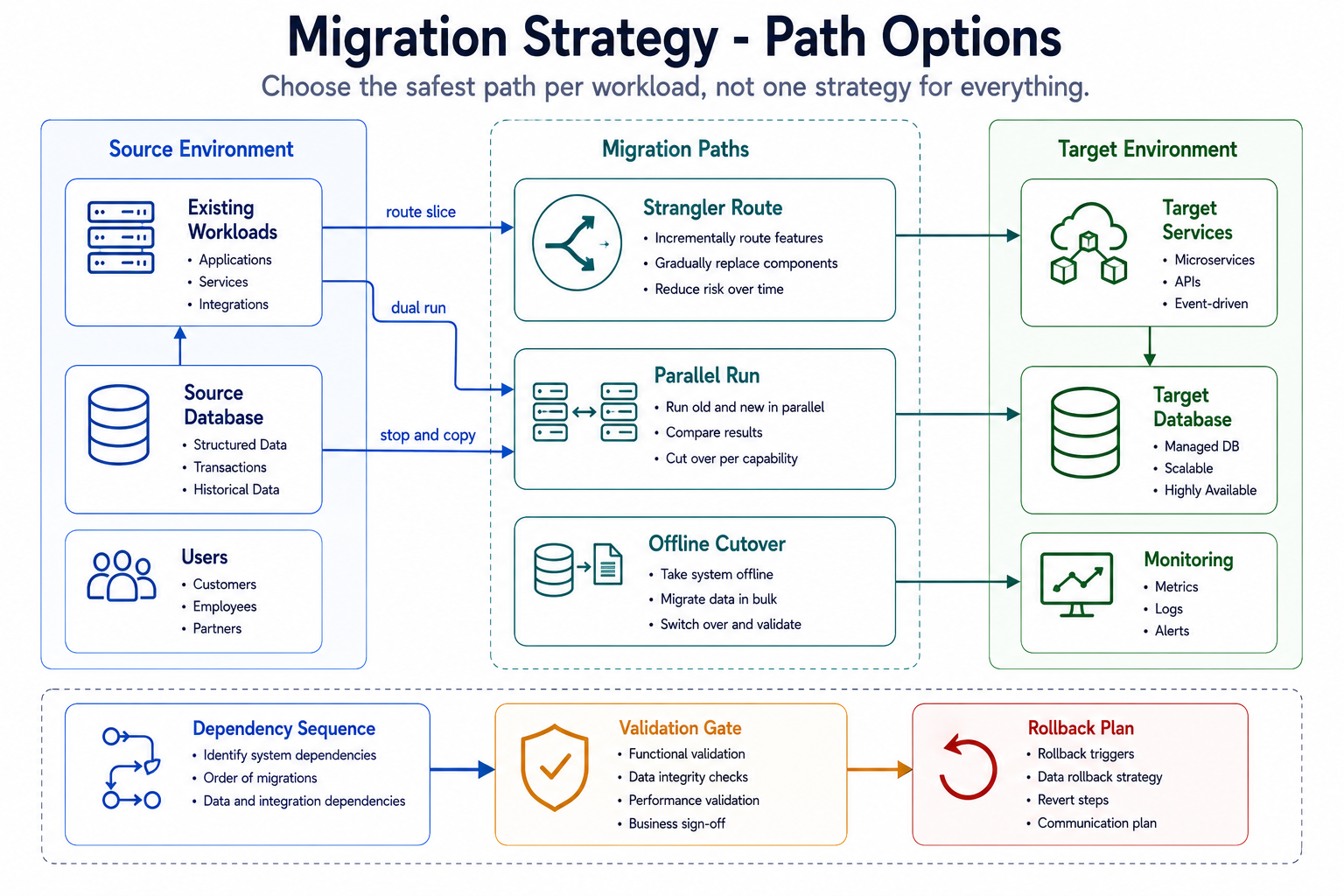
Create a "strangler fig" pattern for tightly coupled systems. Gradually route traffic to the new environment rather than cutting over all at once.
Data Migration Strategy
Data migration is usually the hardest part. Choose the right approach per workload:
%%{init: {'theme': 'neutral', 'themeVariables': {'fontSize': '14px'}}}%%
flowchart TD
    A[Can the workload tolerate downtime?] -->|Yes| B[Is the data set small enough for the window?]
    A -->|No| C[Is continuous replication available?]
    B -->|Yes| D[Offline migration]
    B -->|No| C
    C -->|Yes| E[Online migration]
    C -->|No| F[Dual-write or phased strangler]
    D --> G[Validate and cut over]
    E --> G
    F --> G
| Approach | Description | When to Use |
|---|---|---|
| Offline migration | Stop writes, copy data, start in new environment | Small data sets, tolerance for downtime |
| Online migration | Continuous replication with cutover at a point in time | Large data sets, minimal downtime required |
| Dual-write | Write to both old and new during transition | Zero-downtime requirement, complex validation needed |
| Export/import | Dump and reload | Schema changes required, acceptable downtime window |
For each data migration, define:
- Volume to migrate and estimated transfer time
- Acceptable downtime window
- Validation approach (row counts, checksums, application-level verification)
- Rollback approach if validation fails
- Data sync strategy during the transition period
Network Strategy
- Hybrid connectivity: VPN, Direct Connect, or peering between source and target
- DNS cutover: How traffic will be redirected (weighted routing, blue-green, etc.)
- Latency budget: Which cross-environment calls are acceptable during transition
- Firewall rules: What needs to be opened, when, and who approves
- Certificate management: TLS certificates for new endpoints
Testing Strategy
Each wave needs a test plan:
- Functional testing: Does the workload work in the new environment?
- Performance testing: Does it meet latency and throughput requirements?
- Integration testing: Do upstream and downstream dependencies still work?
- Failover testing: Does the rollback plan actually work?
- Security testing: Are access controls and network policies correctly applied?
Strategy Document Template
Migration Strategy: [Customer Name]
Migration window: [Start] to [End] Total workloads: [X] Waves planned: [X]
Wave Summary:
| Wave | Timeline | Workloads | Risk Level | Key Milestone |
|---|---|---|---|---|
| 1 | [Dates] | [Count] | Low | [Milestone] |
| 2 | [Dates] | [Count] | Medium | [Milestone] |
| 3 | [Dates] | [Count] | High | [Milestone] |
| 4 | [Dates] | [Count] | Low | [Milestone] |
Go/No-Go Criteria per Wave:
- [ ] Target environment validated
- [ ] Rollback plan tested
- [ ] Monitoring and alerting configured
- [ ] Stakeholders briefed
- [ ] On-call coverage arranged for cutover
Communication Plan:
- [Frequency and format of status updates]
- [Escalation path for blockers]
- [Stakeholder notification for cutover events]
⚠️ Gotchas
- Planning all waves in detail upfront — Wave 1 teaches you things that change Waves 2-4
- Underestimating data migration — it's always bigger, slower, and more complex than expected
- Not testing rollback — a rollback plan you haven't tested is not a plan
- Migrating during business-critical periods — avoid peak seasons, quarter-end, product launches
- Ignoring DNS TTLs — if your TTL is 24 hours, your "instant" cutover takes 24 hours
- Assuming the source environment stays stable during migration — changes to source mid-migration cause drift
- Not decommissioning source after migration — dual running costs add up fast
🔗 Links
📚 Further reading
Strategy references, including the incremental-migration pattern:
- AWS — 6 Strategies for Migrating (the 6 R's) — rehost, replatform, refactor, and the rest
- StranglerFigApplication — Fowler — incrementally replacing a legacy system
- Azure Cloud Adoption Framework — Migrate — a staged migration methodology
- Google Cloud — Migration paths — getting-started guidance and reference journeys