Labs
Eight customer-scenario labs that translate architecture decisions into production-ready implementation patterns. Each includes working code, a detailed walkthrough, validation steps, cost notes, and cleanup automation.
DevOps Studio › Labs
New here? Read the Prerequisites and Getting Started guides first, then pick a Learning Path.
On this page: Foundation labs · Advanced labs · How labs are framed · Suggested order
Foundation labs (start here)
| Lab | Customer problem | Implementation details | Time | Difficulty |
|---|---|---|---|---|
| 01 · Terraform Foundations | Establish a secure, repeatable AWS foundation for application workloads | Terraform, AWS VPC, ASG, RDS | 1-2 h | Beginner |
| 02 · Kubernetes Platform | Provide a managed container platform while balancing cost, control, and operational burden | EKS, Helm, kubectl, Ingress | 2-3 h | Intermediate |
| 03 · CI/CD Pipelines | Standardize software delivery from commit to deployment with auditable automation | GitHub Actions, GitLab CI, Jenkins | 1-2 h | Beginner |
Advanced labs
| Lab | Customer problem | Implementation details | Time | Difficulty |
|---|---|---|---|---|
| 04 · Observability Stack | Give operators enough telemetry to detect, investigate, and respond to production issues | Prometheus, Grafana, Jaeger, OpenSearch | 2-3 h | Advanced |
| 05 · Security Automation | Enforce guardrails without slowing delivery teams or relying on manual review alone | Trivy, OPA, Falco, RBAC | 1-2 h | Advanced |
| 06 · GitOps Workflows | Make environment changes reviewable, repeatable, and recoverable through declarative delivery | Kustomize, Argo CD, Flux | 1-2 h | Intermediate |
| 07 · Serverless Operations | Run event-driven workloads with clear ownership, monitoring, and failure handling | Lambda, API Gateway, Step Functions, DynamoDB | 1-2 h | Intermediate |
| 08 · Platform Engineering | Turn repeatable infrastructure patterns into self-service capabilities for delivery teams | Service catalog, platform APIs, automation | 3-4 h | Expert |
How labs are framed
The implementation details matter, but they are not the point. Each lab should make the architectural reasoning visible:
- Customer requirement
- Architecture decision
- Tradeoffs
- Implementation
- Validation
- Operations
Every lab should answer:
- Why would a customer need this?
- When should this be recommended?
- What tradeoffs exist?
- What happens in production?
Suggested order
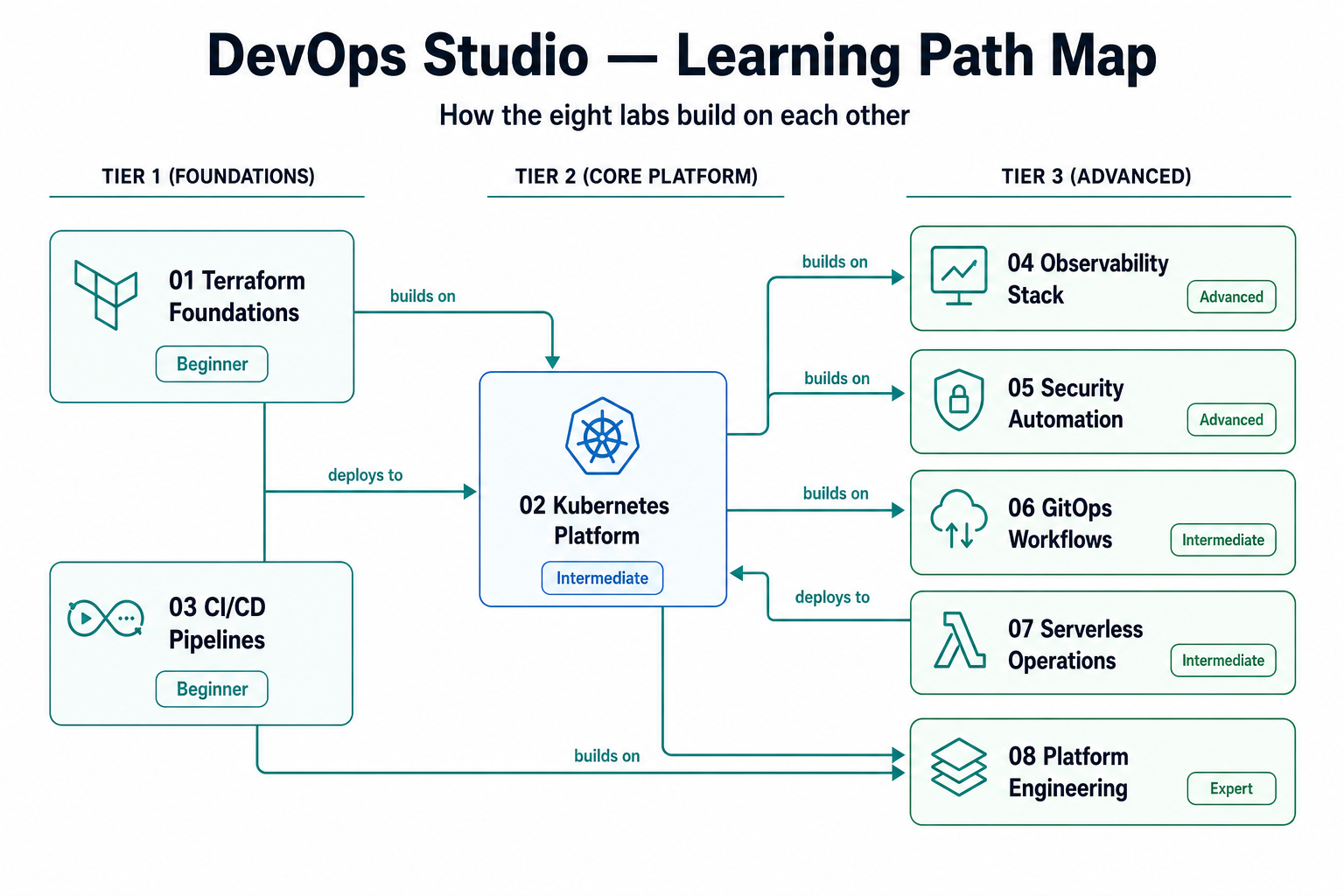
To cover everything, work the labs in order: 01 → 02 → 03 → 04 → 05 → 06 → 07 → 08. To target a specific scenario instead, follow a Learning Path.
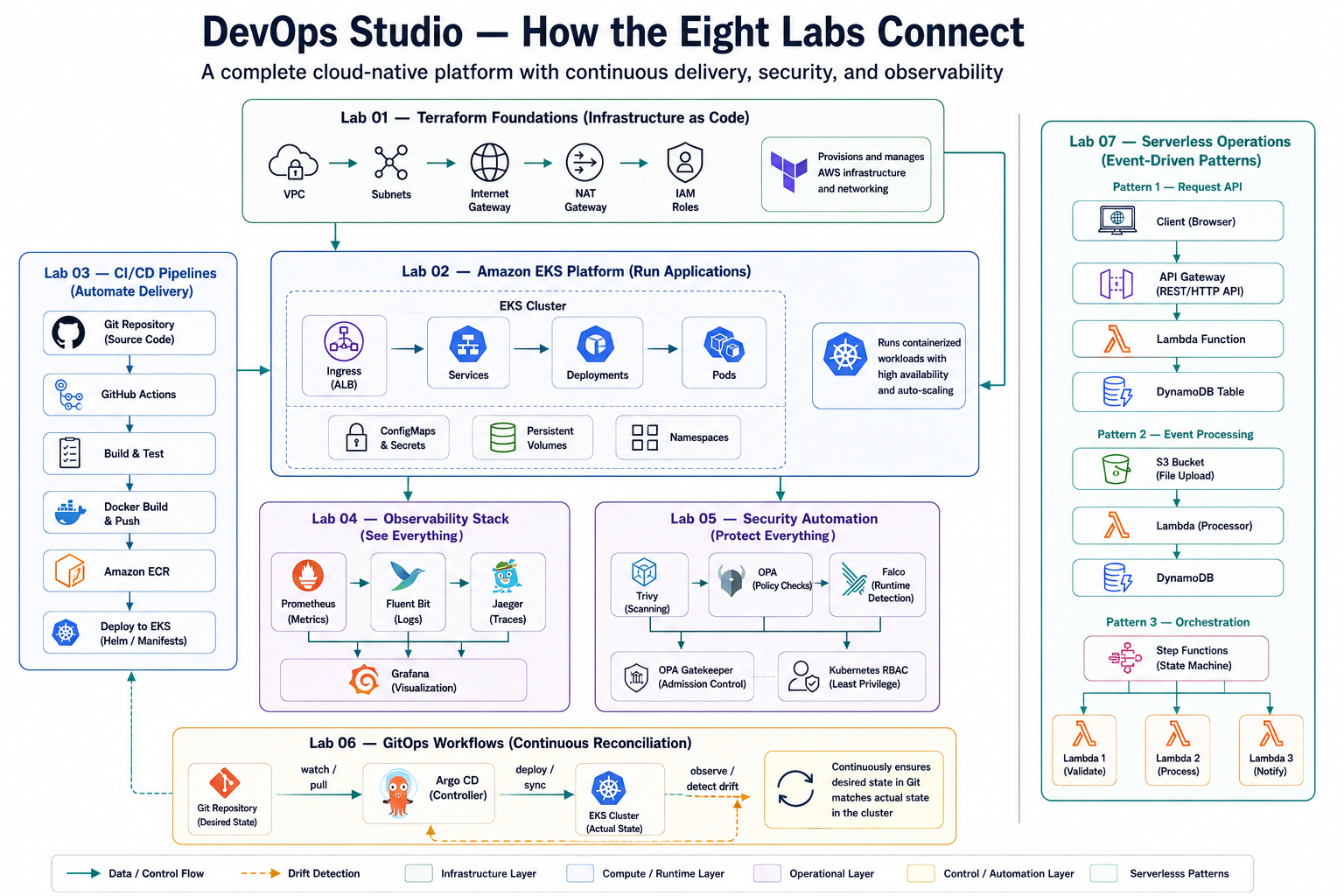
How the labs connect
The map above shows the learning order; this one shows how the labs' systems fit together as a single platform.